I love my job!

I love my job!  Today was my first day of work and, boy, was I nervous.  I didn’t really know where to go or what to do…. I mean, in a general sense I did: go see the patients and be ready to present them.  But where were the patients located?  Where could I find the charts?  What information was I supposed to gather?  All the things I’ll know by heart next week were brand new this morning and a little intimidating.

But I got through pre-rounds.  And I got through attending rounds.  And I got my notes done, and answered pages, and wrote orders, and introduced myself as "Dr. Cook" – and smiled the whole day through. 🙂

I love the people I work with… the other new interns are great, our senior residents are so helpful and generous with their time, the nurses are friendly, and the families are really nice and seem genuinely happy to meet me and have me take over day-to-day care of their children.  What a responsibility, what trust.  I’m so glad I have my seniors to back me up!

Tomorrow I’m on call, and I’m actually kind of excited about it.  I wonder what the day/night will bring…

I love my job.

P.S. Check out http://childrens.jillcook.com for pictures from our climb up Pinnacle Peak that wrapped up our orientation week.  Great fun!

Floating Ribs

A question arose at dinner tonight about floating ribs… what are they, who has them, how many, do women have more than men…. and here’s what I found out:

The ribs are thin, flat, curved bones that form a protective cage around the organs in the upper body.  They are comprised 24 bones arranged in 12 pairs.  These bones are divided into three categories:

The first seven bones are called the true ribs.  These bones are connected to the spine in back.  In the front, these true ribs are connected directly to the breastbone (or sternum) by strips of cartilage called the costal cartilage.

The next three pairs of bones are called false ribs. These bones are slightly shorter than the true ribs and are connected to the spine in back.  However, instead of being attached directly to the sternum in front, the false ribs are attached to the lowest true rib by cartilage.

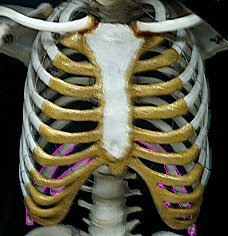
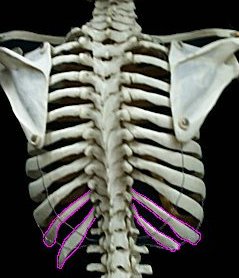
The last two sets of rib bones are called floating ribs.  Floating ribs are smaller than both the true ribs and the false ribs.  They are attached to the spine at the back, but are not connected to anything in the front.

Floating ribs, front view:
Floating ribs, back view:
So, men and women have the same number of ribs.  The idea that women have an extra one is a myth, one that most likely originated with the biblical story of God taking a rib from Adam to create Eve.  I am not disputing that this could have actually, physically happened.  But I do contend that if it did, it would not have created a genetic "missing rib" condition that would be passed on to all mankind – it would have affected only Adam.

Also, just for completeness… Some people have with a pair of "extra" ribs just above the uppermost rib (so called "cervical ribs").  This can result in a condition known as thoracic outlet syndrome.  Along with arm and shoulder pain, it may cause pins-and-needles sensations in the fingers and weakness in your hand grip.  This syndrome can also be cause by other things blocking the nerves/blood supply in the area – such as big muscles, improperly healed trauma, or swelling.

Oh, and another weird thing I read about while looking into this was about floating rib removal.  Apparently, this is a plastic surgery procedure offered by some where most of ribs 11 and 12 (and occasionally rib 10) are removed to give patients a more feminine hourglass figure.  This is a risky surgery with NO indication (so please don’t do it!!).  Besides, the floating ribs are fairly flexible and will gradually yield to the constant pressure of a corset – so go that route if you really want to look that much thinner!


Master Heather

Congratulations go out to my little sister for graduating today with a Masters Degree in Early Childhood Special Education from the University of Washington!

After discussing it with Grandma Cook, we’ve come to the conclusion that from now on she will refer to me as "Doctor" and to Heather as "Master"

🙂

Intern Year

I finally got my block schedule for my intern year yesterday!  I had been waiting for it since late May (when it was first projected to be available).  I am very excited about my schedule and starting residency and, just, everything!  So here it is:

Month 1: Med 1(General Inpatient Service, aka "Floors" or "Wards")
Month 2: Development
Month 3: NICU (Neonatal Intensive Care Unit, located at UW Hospital on Labor/Delivery Floor)
Month 4: Newborn Nursery (located at UW Hospital on Post-partum Floor)
Month 5: Elective (to be determined)
Month 6: Med 2 (general Inpatient)
Month 7: Continuity Clinic/Ambulatory Pediatrics (All clinic work)
Month 8: Hematology/Oncology (Inpatient service for kids with genetic anemias – like Sickle Cell – and with cancer)
Month 9: Emergency Department
Month 10: 2 week vacation and 2 weeks of "float" (where I cover for anyone who is sick, etc.)
Month 11: Med 3 (General Inpatient)
Month 12: Emergency Department

On the Med / NICU / Heme-Onc months I will be on call every 4th night (staying overnight at the hospital).  The Continuity Clinic month is call free (yay!).  When I’m assigned to the Emergency Department (ED), I will work about 18 shifts (8-12 hours each) during each month.  When I’m on my Development and Elective months, I won’t have any call for those services, so I’ll be doing a few shifts in the ED during those months.  When I’m in the Newborn Nursery for a month I’ll help to cover the NICU call nights a few times over the course of the month.  And of course, no call during my vacation, and no call when I’m a float, since I have to be available to come in whenever needed.

 So there it is!  I love that I’m starting on a floor month so I’ll have a chance to learn the new computer system / hospital layout / how rounds work / etc all from the get go.  Also, I think it’s best to be a little shaky on the floors in June (when people know it’s your first time there) rather than not having a floor month until December (like some people have) and have to remind everyone that it’s your first experience there.  I also like the spacing of months with heavier call vs. months with lighter call.  Overall I’m very happy with my whole schedule!